
The Paradox of Progress
Organizations are investing heavily in artificial intelligence, automation, advanced analytics, and digital platforms. The promise is compelling: faster decisions, more personalized customer experiences, greater operational efficiency, and entirely new sources of competitive advantage.
Yet technological progress introduces a question that organizations cannot afford to overlook:
What happens when an organization becomes more technologically capable without becoming more trusted?
A company may deploy sophisticated AI systems, automate critical decisions, and modernize its operating model while employees remain uncertain about leadership intentions, customers question how their information is being used, and business partners struggle to understand how decisions are made.
The technology may work exactly as designed. The organization may still fail to realize its intended value.
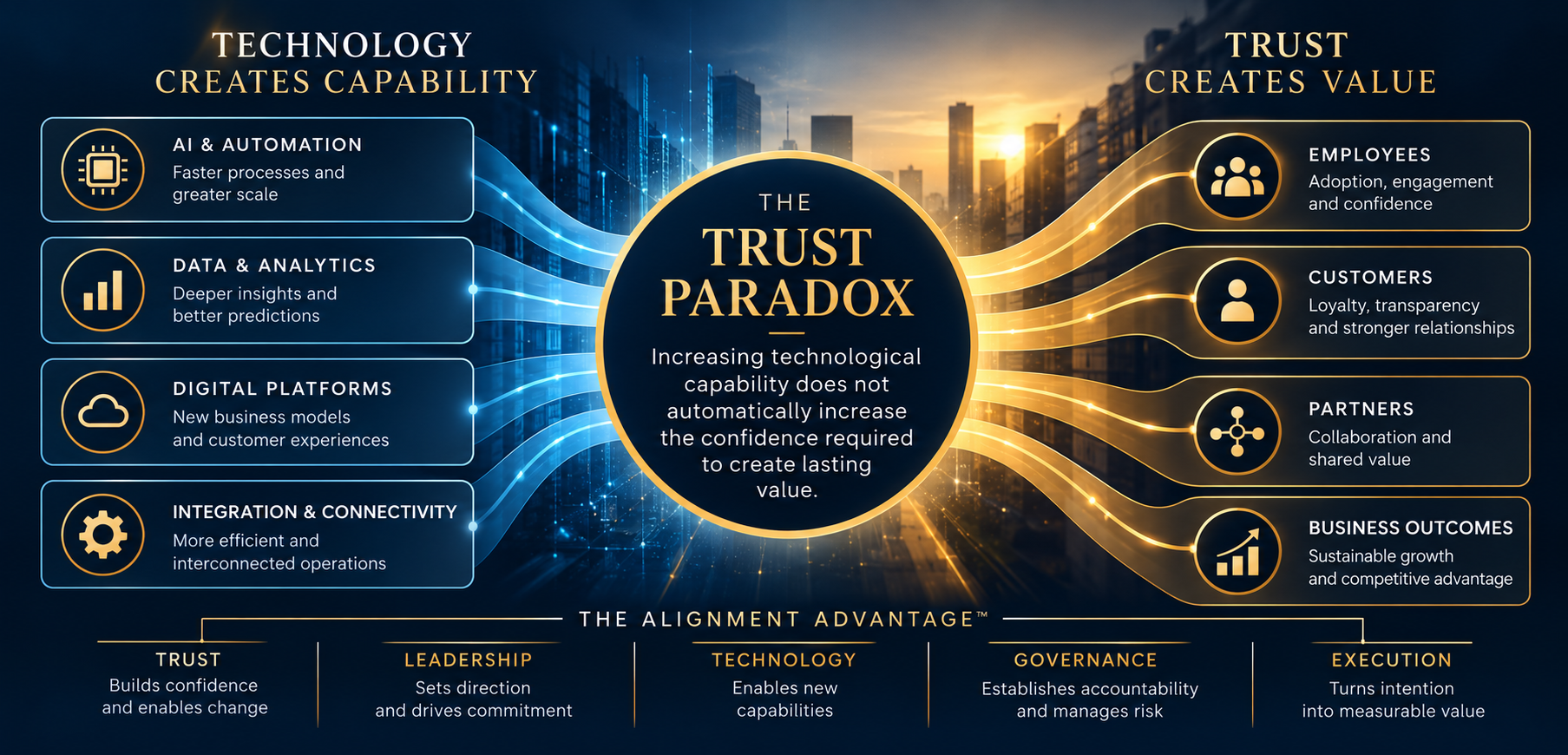
This is the trust paradox: Increasing technological capability does not automatically increase the confidence required to turn that capability into sustainable organizational performance.
The distinction matters because transformation is not simply a technological undertaking. It is a fundamental change in how organizations make decisions, distribute authority, establish accountability, and create value.
And those changes depend on trust.
Technology Can Accelerate Change. Trust Determines Whether It Takes Hold.
Technology can dramatically increase the speed at which organizations operate.
Artificial intelligence can analyze information in seconds that previously required hours. Automation can eliminate repetitive activities. Predictive models can identify opportunities that traditional approaches might overlook.
But faster processes do not necessarily create stronger organizational relationships.
Consider a hypothetical B2B organization implementing an AI-powered customer intelligence platform.
From a technical perspective, the implementation is successful. Data sources are integrated, predictive models are operational, and sales and marketing teams have access to more sophisticated customer insights.
Yet several challenges emerge.
Sales professionals question the recommendations because they do not understand how the models reach their conclusions. Marketing leaders interpret the same customer signals differently. Customers become concerned about the increasing use of automated personalization. Senior executives disagree about who owns decisions influenced by AI.
The organization has improved its technological capabilities without establishing the shared confidence necessary to use them effectively.
This is not necessarily a failure of technology.
It is a failure to align technological advancement with the human and organizational conditions required for adoption.
The Trust Paradox: When Capability Outpaces Confidence
The challenge can be understood through the relationship between technological advancement and the confidence required to turn that advancement into organizational value.
Trust Is Not a Soft Variable. It Is an Organizational Capability.
Trust is frequently discussed as an element of corporate culture, employee engagement, or brand reputation.
Those perspectives are important, but they can underestimate its strategic significance.
In transformation, trust influences whether employees adopt new systems, whether leaders delegate decision-making authority, whether customers accept new experiences, and whether external partners collaborate across organizational boundaries.
Trust therefore deserves consideration as an organizational capability rather than simply a desirable cultural characteristic.
Three dimensions are particularly important.
1. Internal Trust: Confidence Within the Organization
Employees must understand not only how new technologies work, but why they are being introduced and how their roles may change.
When leaders communicate transformation primarily through productivity targets and efficiency gains, employees may interpret the initiative through the lens of job security, professional relevance, or diminished autonomy.
This does not mean employees inevitably resist AI. Many embrace technology that improves their work.
The critical difference is whether leadership establishes credible expectations, provides opportunities to develop new capabilities, and demonstrates consistency between stated intentions and actual decisions.
Internal trust is strengthened when employees can understand the transformation and participate meaningfully in its execution.
2. External Trust: Confidence Across the Customer Relationship
Customers increasingly interact with organizations through AI-enabled experiences, automated service channels, and data-driven personalization.
These capabilities can improve convenience, relevance, and responsiveness.
However, customers may evaluate technological sophistication differently from the organizations deploying it.
A company may celebrate increased automation while customers question transparency, privacy, accountability, or access to human assistance.
For example, an AI-enabled service experience may resolve routine requests more quickly but undermine confidence if customers cannot understand or challenge an important decision.
The managerial challenge is not choosing between automation and human interaction.
It is determining where automation creates value, where human judgment remains essential, and how the organization communicates that distinction.
3. Ecosystem Trust: Confidence Beyond Organizational Boundaries
Enterprise transformation rarely occurs within a single organization.
Technology vendors, suppliers, implementation partners, distributors, and customers often participate in interconnected value chains.
An organization may achieve strong internal adoption while external partners remain unable or unwilling to participate fully.
Data-sharing expectations may differ. Decision rights may be unclear. Partners may disagree about how risks, costs, and benefits should be distributed.
These conditions can limit the value of otherwise successful transformation investments.
The true test of alignment is not simply whether an organization can deploy technology internally, but whether the broader ecosystem can participate in creating value from it.
This is particularly relevant to B2B organizations, where customer relationships and commercial outcomes often depend on coordinated activity across multiple companies.
The Leadership Challenge: Moving Beyond Adoption Metrics
Organizations commonly evaluate digital transformation through measurable indicators such as system utilization, process efficiency, automation rates, and implementation milestones.
These measures provide important operational information.
But they do not tell the entire story.
A platform can achieve high adoption while employees continue relying on informal workarounds. A customer-facing AI tool can process thousands of interactions without strengthening customer confidence. A transformation program can meet its implementation targets while creating new uncertainty about accountability.
Leadership must therefore distinguish among three outcomes:
Implementation: Has the technology been successfully deployed?
Adoption: Are employees, customers, and partners using the new capabilities?
Value realization: Are those capabilities producing meaningful, sustainable improvements in organizational and customer outcomes?
These outcomes are related, but they are not interchangeable.
The leadership challenge is to connect them through a coherent operating model that establishes expectations, reinforces accountability, and creates the conditions for confidence.
This requires moving beyond the assumption that technology adoption alone represents transformation success.
Governance: Where Trust Becomes Operational
Trust cannot depend entirely on leadership messaging or organizational goodwill.
It must be reinforced through governance.
In an AI-enabled organization, governance determines who can make decisions, how those decisions are reviewed, which risks require escalation, and how accountability is maintained.
Consider an AI system recommending changes to customer pricing, sales priorities, or service eligibility.
Who is responsible for validating the recommendation?
When should a human intervene?
How are errors identified and corrected?
What information should be communicated to affected customers?
If these questions remain unresolved, employees may hesitate to act, leaders may disagree about ownership, and customers may experience inconsistent outcomes.
Effective governance does not eliminate every uncertainty. Nor does greater oversight automatically create trust.
Excessively restrictive controls can slow decisions and discourage innovation.
The objective is proportionate governance: enough clarity, transparency, and accountability to support responsible action without unnecessarily limiting organizational adaptability.
Trust becomes more durable when organizations translate their stated principles into observable decisions, consistent practices, and meaningful accountability.
The Alignment Advantage: Five Forces, One System
The Trust Paradox reveals why transformation cannot be understood through technology alone.
Within The Alignment Advantage™, organizational transformation is viewed through five interdependent forces:
Trust establishes the confidence necessary for individuals and organizations to participate in change.
Leadership defines direction, shapes expectations, and reinforces organizational commitment.
Technology enables new capabilities, processes, and opportunities for value creation.
Governance establishes decision rights, accountability, and the mechanisms necessary to manage complexity.
Execution translates organizational intentions into measurable operational and commercial outcomes.
Each force contributes something different.
Technology without trust may encounter hesitation or resistance.
Trust without leadership may lack strategic direction.
Leadership without governance may create inconsistent decisions.
Governance without execution may produce control without progress.
Execution without alignment may deliver activity without realizing the intended value.
The central proposition is not that every force must receive equal attention at every moment.
Rather, transformation performance depends on how effectively organizations coordinate these forces as conditions change.
A technically advanced organization may still struggle if its leadership, governance, and customer relationships are not prepared to support the capabilities being introduced.
Conversely, an organization with strong relationships and clear accountability may be better positioned to translate technological investments into sustainable results.
This is the broader opportunity of alignment: to connect what an organization can do with what its people, customers, and partners are prepared to support.
Five Questions Every Executive Should Ask
Before launching or expanding a major AI-enabled transformation initiative, executives should consider five questions.
1. Are we measuring technological adoption or actual confidence?
Usage statistics can reveal activity, but they may not explain whether employees and customers understand, trust, or benefit from new capabilities.
2. Do employees understand how AI will influence their work and decisions?
Clear communication, practical training, and meaningful participation can help establish credible expectations.
3. Have we established accountability for AI-influenced decisions?
Decision rights, escalation procedures, and oversight responsibilities should be explicit, particularly when decisions affect customers or external partners.
4. Are our customers and ecosystem partners prepared for the transformation?
Internal implementation success does not guarantee external readiness. Organizations must consider the capabilities, expectations, and incentives of the wider value chain.
5. Can we demonstrate that technological progress is creating meaningful value?
Executives should connect implementation and adoption measures to customer outcomes, organizational performance, and longer-term strategic objectives.
These questions shift the conversation from whether an organization possesses advanced technology to whether it has established the conditions necessary to benefit from it.
The Future of Transformation Will Be Defined by Confidence, Not Capability Alone
Artificial intelligence will continue to reshape how organizations operate, compete, and create value.
As technological capabilities advance, the distinction between organizations that successfully deploy AI and those that realize lasting value from it may become increasingly important.
Trust will not automatically emerge from faster systems, better algorithms, or more sophisticated platforms.
It must be supported through leadership decisions, governance mechanisms, employee experiences, customer relationships, and consistent execution.
Nor should trust be treated as a substitute for technical performance. Reliable technology, responsible data practices, and demonstrable outcomes remain essential.
The opportunity lies in connecting these elements rather than managing them independently.
The next competitive advantage may not belong simply to the organizations with the most advanced technology, but to those that can align technological capability with the confidence required to create value.
That is the trust paradox.
And resolving it is part of The Alignment Advantage™.