
The Invisible Cost of Transformation
Organizations rarely begin transformation initiatives expecting them to fail.
They invest in strategic planning, engage experienced leaders, introduce new technologies, and establish ambitious performance objectives. Transformation programs are launched with executive sponsorship, detailed roadmaps, and clearly articulated expectations.
Yet even organizations with strong strategies and substantial resources can struggle to translate transformation investments into meaningful business outcomes.
The problem is not always a lack of vision, talent, or technological capability.
Sometimes, the greatest obstacle is something far less visible.
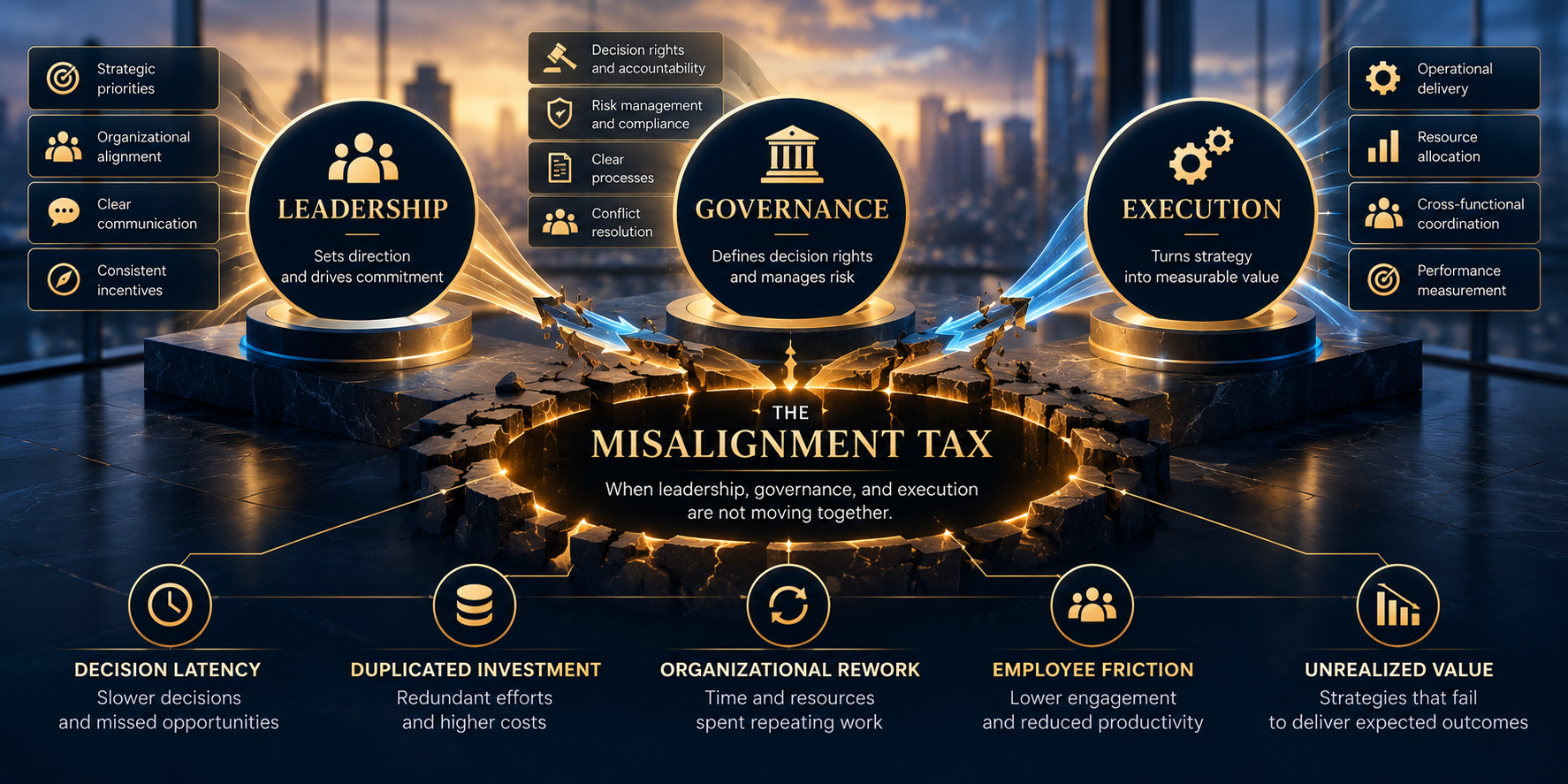
The organization is moving forward, but its leadership, governance, and execution mechanisms are not moving together.
Leadership communicates one set of priorities. Governance structures reinforce another. Operational teams are measured against objectives that do not fully support either.
Individually, each component may appear functional. Collectively, they create friction that limits organizational performance.
This is the hidden cost of misalignment.
Unlike an unsuccessful technology implementation or a missed financial target, organizational misalignment does not always appear as a single identifiable failure. Instead, it can accumulate through delayed decisions, duplicated efforts, inconsistent priorities, employee frustration, and opportunities that never reach their full potential.
The consequences can extend beyond internal efficiency.
Customers experience inconsistent service. Business partners encounter conflicting expectations. Employees lose confidence in transformation initiatives. Leadership teams struggle to understand why strategic progress remains slower than anticipated.
The challenge is not simply executing a strategy. It is ensuring that the organizational system responsible for execution is capable of delivering it.
Why Good Strategies Fail Inside Capable Organizations
Traditional explanations for transformation failure often emphasize poor planning, insufficient resources, inadequate communication, or resistance to change.
These factors can certainly contribute to disappointing outcomes.
However, they do not fully explain why organizations with experienced executives, sophisticated technologies, and well-developed strategies still encounter persistent execution challenges.
Consider a hypothetical global B2B enterprise undertaking a major digital transformation.
Executive leadership establishes a strategic objective to improve customer experience through integrated data, AI-enabled decision-making, and greater coordination across business units.
The technology organization prioritizes platform modernization and system integration.
Marketing focuses on customer engagement and personalization.
Sales leadership emphasizes near-term revenue generation and account productivity.
Finance introduces tighter investment controls.
Regional business leaders maintain operational targets shaped by local market requirements.
Each function is pursuing objectives that can be justified independently.
Yet the transformation begins to lose momentum.
Technology investments are delayed because funding decisions remain unresolved. Marketing develops new capabilities that sales teams are not prepared to adopt. Regional leaders resist standardized processes that conflict with local performance expectations. Customer data becomes more accessible, but accountability for using it remains fragmented.
No single function is necessarily performing poorly.
The problem is that functional success does not automatically produce enterprise success.
This distinction is fundamental to understanding organizational alignment.
A company can contain highly capable teams, effective individual leaders, and advanced technology while still lacking the coordination necessary to achieve its strategic objectives.
Transformation requires more than excellence within organizational functions.
It requires coherence across them.
The Three-Way Collision: Leadership, Governance, and Execution
Three organizational forces are particularly important when examining how strategic intentions become operational outcomes.
Leadership establishes direction.
Governance determines how decisions are made.
Execution converts decisions into action.
When these forces reinforce one another, organizations may be better positioned to coordinate resources, resolve competing priorities, and respond to changing conditions.
When they operate independently, transformation becomes vulnerable to fragmentation.
1. Leadership Without Operational Alignment
Leadership plays a central role in defining strategic priorities, communicating organizational purpose, and establishing expectations for change.
However, strategic direction alone does not guarantee coordinated execution.
Executives may articulate a compelling transformation vision without addressing how competing priorities will be resolved across departments, business units, or geographic markets.
For example, leadership may announce that customer experience is the organization’s highest strategic priority while continuing to reward individual functions primarily for cost reduction, short-term revenue, or operational efficiency.
Employees then face competing signals.
Should they prioritize the customer experience or the performance measures used to evaluate their work?
Should they collaborate across functions or protect the resources necessary to meet departmental objectives?
When these questions remain unresolved, employees often respond to the incentives and authority structures closest to them.
The result is not necessarily resistance to leadership.
It may be a rational response to organizational inconsistency.
Leadership alignment requires more than agreement on strategic direction. It requires consistency between stated priorities, organizational incentives, resource allocation, and operational expectations.
2. Governance Without Decision Clarity
Governance is often associated with oversight, compliance, risk management, and organizational control.
These responsibilities are important, particularly as organizations adopt AI-enabled technologies and increasingly interconnected operating models.
But governance also determines how efficiently an organization can make and implement decisions.
When decision rights are unclear, teams may seek approval from multiple stakeholders. When accountability is fragmented, problems move between functions without clear ownership. When escalation mechanisms are poorly defined, routine decisions can become prolonged negotiations.
An organization may have numerous governance committees and still lack effective decision-making.
More governance does not necessarily mean better governance.
In some cases, additional layers of oversight can introduce complexity without improving accountability.
The objective should be to establish governance mechanisms that provide sufficient clarity, consistency, and control while enabling the organization to act.
Effective governance helps answer essential questions:
Who owns the decision?
Who must contribute?
Who is accountable for the outcome?
How are conflicts resolved?
When should an issue be escalated?
Without clear answers, execution teams may spend more time navigating the organization than delivering value.
Governance creates strategic value when it enables responsible decisions rather than merely increasing organizational oversight.
3. Execution Without Enterprise Coordination
Execution is where strategic ambition encounters operational reality.
It involves the daily decisions, processes, resources, and behaviors that determine whether transformation objectives become measurable outcomes.
Yet execution is frequently managed through individual projects, functions, or business units rather than through the broader enterprise system.
Project teams may meet their deadlines while dependencies remain unresolved elsewhere.
Technology platforms may launch successfully without the organizational processes necessary to support adoption.
Departments may achieve their performance targets while enterprise-level transformation outcomes remain disappointing.
These conditions reveal an important distinction between completing activities and realizing value.
Execution success cannot be evaluated solely by whether individual initiatives are delivered. It must also consider whether those initiatives collectively advance the organization’s strategic objectives.
This requires coordinated priorities, clearly defined dependencies, shared accountability, and meaningful measures of business outcomes.
The Misalignment Tax: Costs Organizations Rarely Measure
Financial reporting captures many direct transformation expenses, including technology investments, consulting services, training, and operational expenditures.
But organizational misalignment can generate additional costs that are difficult to isolate within traditional financial measures.
These costs may appear across several dimensions.
Decision Latency
When decision rights are unclear or competing priorities remain unresolved, decisions take longer than necessary.
The consequences can include delayed product launches, slower customer responses, extended implementation timelines, and missed market opportunities.
The cost is not limited to the time spent waiting.
It also includes the value of opportunities that could have been pursued sooner.
Duplicated Investment
Functions operating independently may develop overlapping capabilities, purchase similar technologies, or establish redundant processes.
These investments may be individually reasonable but collectively inefficient.
Without enterprise coordination, organizations risk paying multiple times for capabilities that could have been shared or integrated.
Organizational Rework
Misaligned expectations often produce work that must be revised, repeated, or abandoned.
Teams may develop solutions before governance requirements are clarified. Technology may be configured before operating processes are agreed upon. Customer experiences may be redesigned without sufficient input from the employees responsible for delivering them.
Rework consumes resources while delaying value realization.
Employee Friction
Employees working within misaligned systems must navigate conflicting priorities, ambiguous responsibilities, and inconsistent leadership expectations.
Over time, these conditions can weaken engagement, reduce confidence in transformation initiatives, and increase the effort required to complete routine activities.
Even highly motivated employees may struggle to perform effectively when the organizational environment creates unnecessary obstacles.
Customer and Ecosystem Friction
Internal misalignment does not remain confined within organizational boundaries.
Customers may encounter inconsistent communications, fragmented service experiences, or delays caused by unresolved internal dependencies.
Suppliers and business partners may face competing requirements from different parts of the same enterprise.
These experiences can undermine relationships and limit the broader value of transformation investments.
Taken together, these effects can be understood as a misalignment tax: the accumulated operational and economic burden created when organizational priorities, decision structures, and execution activities fail to reinforce one another.
The term is a conceptual way to describe these costs, not a standardized financial metric.
Its managerial value lies in making an often-overlooked problem more visible.
Why Technology Can Amplify Organizational Misalignment
Artificial intelligence and digital transformation introduce a new dimension to the alignment challenge.
Technology can increase the speed, scale, and interconnectedness of organizational activity.
But it does not automatically resolve inconsistencies in leadership priorities, governance structures, or operating processes.
In some circumstances, technology may amplify those inconsistencies.
Consider an organization implementing AI-enabled workflow automation across several business functions.
If decision rights are clear, processes are coordinated, and accountability is established, automation may improve efficiency and responsiveness.
If those conditions are absent, the organization may automate fragmented processes, accelerate inconsistent decisions, or scale operational problems that previously affected only a limited number of activities.
The technology is not necessarily defective.
It is operating within an organizational system that was not adequately aligned before implementation.
This raises a critical question for executives:
Are we using technology to improve how the organization operates, or are we simply accelerating the way it already operates?
The distinction is particularly important as AI moves beyond individual productivity tools into enterprise workflows, customer interactions, and cross-organizational decision-making.
The more interconnected the technology, the more consequential unresolved organizational dependencies may become.
Technology modernization should therefore be accompanied by deliberate consideration of leadership alignment, governance effectiveness, workforce readiness, and execution capabilities.
Otherwise, organizations risk digitizing complexity rather than eliminating it.
The Alignment Advantage: Five Forces, One Organizational System
The hidden cost of misalignment extends beyond leadership, governance, and execution.
These forces operate within a broader organizational system that also includes trust and technology.
The Alignment Advantage™ examines transformation through five interconnected forces:
Trust influences confidence, collaboration, and the willingness of employees, customers, and partners to participate in change.
Leadership establishes strategic direction, shapes organizational priorities, and reinforces expectations.
Technology enables new capabilities, processes, and opportunities for value creation.
Governance defines decision rights, accountability, oversight, and mechanisms for resolving complexity.
Execution translates strategic intentions into operational activity and measurable outcomes.
The central challenge is not simply strengthening each force independently.
It is understanding how they interact.
Strong leadership may establish direction, but weak governance can prevent timely decisions.
Advanced technology may create new capabilities, but limited trust can constrain adoption.
Effective governance may clarify accountability, but fragmented execution can prevent coordinated results.
Strong execution within individual functions may still fail to produce enterprise value when strategic priorities remain inconsistent.
The Alignment Advantage proposes that sustainable transformation requires organizations to manage these interdependencies deliberately rather than treating leadership, technology, governance, trust, and execution as separate management concerns.
This perspective shifts attention from individual transformation activities toward the broader organizational conditions that influence their effectiveness.
It also creates an opportunity to examine alignment beyond the boundaries of the enterprise.
In B2B environments, transformation outcomes frequently depend on the readiness and coordination of customers, suppliers, technology providers, and other ecosystem partners.
An organization may be internally aligned while still encountering external constraints that limit value realization.
The future of transformation management may therefore require a more integrated understanding of both internal organizational alignment and external ecosystem coordination.
From Functional Excellence to Enterprise Alignment
If organizational misalignment creates hidden costs, executives must consider how those costs can be identified and reduced.
The answer is not necessarily another transformation program, additional governance committees, or a more elaborate operating model.
Instead, organizations can begin by examining whether their existing management mechanisms reinforce the same strategic objectives.
Several practices deserve consideration.
Establish Shared Strategic Priorities
Transformation priorities should be translated into expectations that are meaningful across functions.
This includes identifying where departmental objectives support enterprise goals and where they may create competing incentives.
Alignment does not require every function to perform identical activities.
It requires a shared understanding of how different contributions support common outcomes.
Clarify Decision Rights and Accountability
Organizations should identify critical transformation decisions and establish who is responsible for making them.
Decision processes should reflect the significance and risk of the decision without introducing unnecessary complexity.
Clear ownership can reduce ambiguity, improve responsiveness, and support more consistent execution.
Connect Technology Investments to Operating Model Readiness
Before deploying new capabilities, leaders should assess whether processes, roles, incentives, and governance mechanisms are prepared to support them.
Technology implementation and organizational readiness should be treated as connected responsibilities.
Measure Enterprise Outcomes, Not Only Functional Performance
Project milestones and departmental performance indicators remain useful.
However, they should be complemented by measures that reflect cross-functional outcomes, customer value, operational coordination, and the realization of strategic benefits.
This can help executives distinguish local success from enterprise progress.
Extend Alignment Beyond Organizational Boundaries
For organizations operating within complex value chains, alignment should include the capabilities and expectations of external partners.
Customer readiness, supplier coordination, data-sharing practices, and ecosystem governance can influence whether internal transformation investments achieve their intended results.
These practices do not guarantee transformation success.
They provide a more deliberate approach to identifying and managing the organizational conditions that can support or constrain it.
Five Questions Every Executive Should Ask
Before committing additional resources to a transformation initiative, executive teams should consider five questions.
1. Are our functions pursuing the same enterprise outcomes?
Examine whether departmental objectives, incentives, and investment priorities reinforce the broader transformation strategy.
2. Do we know where decisions become delayed or fragmented?
Identify the governance mechanisms, approval processes, and accountability gaps that may be slowing execution.
3. Are we measuring completed activities or realized business value?
Evaluate whether implementation milestones are connected to meaningful improvements in customer experience, operational performance, and strategic outcomes.
4. Are our technology investments improving the operating model or automating existing complexity?
Determine whether new capabilities are supported by appropriate processes, roles, decision rights, and organizational readiness.
5. Are our customers and ecosystem partners aligned with the transformation?
Consider whether external dependencies, incentives, and capabilities support the value the organization intends to create.
These questions encourage leaders to look beyond the performance of individual initiatives and examine the effectiveness of the organizational system as a whole.
The Future of Transformation Requires a Different Definition of Success
Organizations will continue to invest in artificial intelligence, digital platforms, operating model modernization, and new approaches to enterprise performance.
These investments can create substantial opportunities.
But technology alone cannot resolve conflicting priorities, unclear accountability, or fragmented execution.
Nor can a compelling strategy overcome an organizational system that consistently works against its intended outcomes.
The challenge for executive leadership is to recognize that transformation success depends not only on what an organization invests in, but also on how effectively its people, decisions, technologies, and processes work together.
Misalignment may not appear as a single line item in a financial statement.
Its consequences can nevertheless emerge through delayed decisions, duplicated investments, organizational rework, employee friction, weakened customer experiences, and unrealized opportunities.
The organizations best positioned to address these challenges may be those that treat alignment as a continuous management responsibility rather than a one-time transformation activity.
The next competitive advantage may not come from having the strongest individual functions, the most advanced technology, or the most ambitious strategy.
It may come from building an organization in which leadership, governance, technology, trust, and execution consistently reinforce one another.
Because the true cost of transformation is not always what an organization spends.
Sometimes, it is the value the organization never realizes.
That is the hidden cost of misalignment.
And addressing it is at the heart of The Alignment Advantage™.