

The Transformation Paradox
Organizations have never had more sophisticated tools for transformation.
Artificial intelligence is reshaping how decisions are made. Digital platforms are redefining customer experiences. Advanced analytics are giving leaders unprecedented visibility into performance. Enterprises are investing heavily in modernization, automation, and new operating models.
Yet a fundamental challenge persists.
Organizations can develop compelling strategies, secure executive sponsorship, deploy advanced technologies, and establish comprehensive governance structures- only to discover that the expected business outcomes remain elusive.
Why?
Because having the right strategy is not the same as having an organization capable of executing it.
A transformation strategy may be clear at the executive level while its interpretation varies across business functions. Technology teams may deliver the capabilities requested, while operational teams struggle to integrate them. Leadership may celebrate implementation milestones even as customers and employees experience limited improvement.
Individually, these activities can appear successful.
Collectively, they may fail to produce the intended result.
This is the central tension behind The Alignment Advantage™: transformation success depends not simply on the quality of individual organizational capabilities, but on how effectively those capabilities work together to create value.
The Problem Is Often Between the Functions
Traditional transformation management frequently organizes work around functional responsibilities.
Strategy teams define direction. Technology teams implement systems. Human resources supports organizational change. Finance manages investment and performance. Operations translates new capabilities into daily activity.
This division of responsibility is necessary. Large enterprises cannot function without specialization.
The challenge emerges when functional success becomes disconnected from enterprise outcomes.
Consider a hypothetical B2B organization implementing an AI-enabled customer engagement platform.
The technology team successfully deploys the platform. Marketing increases campaign automation. Sales receives new customer insights. Operations introduces updated workflows.
Each function reports progress against its assigned objectives.
However, sales teams question the relevance of AI-generated recommendations. Customer information remains inconsistent across systems. Employees are uncertain about decision authority. Leadership receives positive implementation reports but limited evidence of improved customer outcomes.
The technology works.
The individual teams have delivered.
The transformation has not yet created the value originally envisioned.
This distinction matters because organizations often measure what they have implemented more readily than what they have changed.
A deployed platform is an output. Improved customer value, stronger organizational responsiveness, or sustained operational performance is an outcome.
The two are connected, but they are not interchangeable.
The critical management question becomes: Who is accountable for ensuring that functional accomplishments combine into the intended enterprise result?
Alignment Is Not the Same as Agreement
Organizational alignment is sometimes interpreted as consensus: leaders agree on priorities, teams understand the strategy, and everyone supports the transformation.
But agreement alone is insufficient.
An executive team may unanimously endorse a strategic objective while maintaining conflicting incentives, competing resource priorities, and incompatible definitions of success.
True alignment requires more than shared intentions.
It requires coordinated decisions, consistent accountability, and the ability to resolve trade-offs across organizational boundaries.
For example, a marketing leader may prioritize personalization, a technology leader may prioritize platform standardization, and a finance leader may prioritize cost efficiency.
Each objective can be legitimate.
The transformation challenge is not eliminating those differences. It is creating the conditions in which competing priorities can be reconciled in service of a common enterprise outcome.
Alignment, therefore, should not mean organizational uniformity.
It should mean the capacity to make coherent decisions across functions, particularly when legitimate priorities compete.
This distinction becomes increasingly important as organizations adopt AI technologies that influence decisions across multiple business functions.
Technology can accelerate activity without resolving disagreement about what the activity should accomplish.
In some circumstances, it may simply accelerate existing fragmentation.
Five Interdependent Forces of Transformation
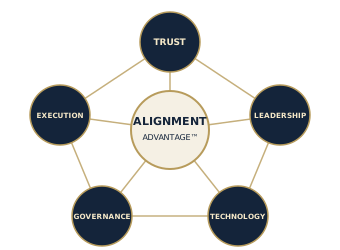
The Alignment Advantage™ examines transformation through five interconnected organizational forces: Trust, Leadership, Technology, Governance, and Execution.
These forces provide an organizing framework for investigating how transformation operates across an enterprise. They should be understood as interconnected management lenses rather than a scientifically validated formula for predicting success.
Trust: The Foundation of Organizational Confidence
Transformation requires people to accept uncertainty, change established behaviors, and make decisions with imperfect information.
Trust influences whether employees believe leadership’s intentions, whether functions share information openly, and whether customers have confidence in evolving organizational capabilities.
In AI-enabled environments, trust also involves questions of transparency, reliability, accountability, and appropriate human oversight.
Trust does not eliminate the need for controls. It creates conditions in which coordination and responsible adoption may become more feasible.
Leadership: Translating Direction Into Organizational Coherence
Leadership is more than setting an ambitious vision.
Executives must reconcile competing priorities, communicate the rationale behind decisions, and establish shared expectations across functions.
A transformation can have strong executive sponsorship and still experience fragmented leadership behavior.
The relevant question is not simply whether leaders support the strategy, but whether their decisions consistently reinforce it.
Technology: Enabling Value Rather Than Defining Success
Technology expands what organizations can accomplish.
AI, automation, integrated data platforms, and digital infrastructure can improve speed, insight, and scalability.
However, technological capability does not automatically translate into organizational value.
That translation depends on how tools are incorporated into decisions, workflows, customer interactions, and performance expectations.
A technically successful implementation can coexist with disappointing business outcomes.
Governance: Connecting Accountability to Decisions
Governance provides structures for decision rights, risk management, investment oversight, and organizational accountability.
But formal governance is not necessarily effective governance.
Committees can exist without resolving trade-offs. Accountability charts can be complete while decision authority remains ambiguous. Approval processes can be rigorous while cross-functional coordination remains weak.
The essential distinction is between the presence of governance structures and their effectiveness in guiding real decisions.
Execution: Turning Organizational Capability Into Results
Execution is where strategic ambition encounters operational reality.
It requires coordinated activity across functions, consistent prioritization, feedback, and the ability to adjust when assumptions prove incorrect.
Execution should not be evaluated solely through project completion, system deployment, or activity metrics.
Its ultimate relevance lies in whether organizational action produces meaningful, sustained outcomes.
These five forces interact. Their relationships—and the conditions under which they matter most—deserve careful examination rather than assumptions of universal causality.
Why AI Raises the Stakes
Artificial intelligence introduces a particularly important dimension to organizational alignment.
Unlike many earlier technology investments, AI can influence not only how work is performed but also how recommendations are generated, information is interpreted, and decisions are supported.
This creates opportunities for significant improvements in productivity, responsiveness, and customer engagement.
It also creates new coordination demands.
Who determines whether an AI-generated recommendation is sufficiently reliable? Who owns the customer outcome when several functions contribute to an AI-enabled process? How are conflicting priorities resolved when speed, personalization, compliance, and cost efficiency pull in different directions?
These are not exclusively technology questions.
They are questions of leadership, trust, governance, and execution.
An organization may possess advanced AI capabilities while lacking agreement about how those capabilities should be used.
The resulting challenge is not necessarily technological underperformance.
It may be an inability to translate technological potential into coordinated organizational action.
This suggests a critical executive consideration: AI readiness and organizational alignment should be evaluated together, rather than treated as separate transformation agendas.
From Implementation Success to Value Realization
One of the most consequential distinctions in transformation management is the difference between delivering a capability and realizing its value.
Organizations routinely establish milestones for technology deployment, process redesign, training completion, and operational adoption.
These measures are useful. They help leaders understand whether planned activities are progressing.
But they do not independently establish whether the transformation is achieving its strategic purpose.
A customer engagement initiative may increase the volume of personalized communications without improving customer relationships.
An automation program may reduce manual tasks without meaningfully improving end-to-end performance.
A governance redesign may clarify formal responsibilities without accelerating consequential decisions.
These possibilities illustrate why transformation measurement must extend beyond implementation.
Leaders should examine the chain connecting investment, organizational decisions, changed behavior, and realized outcomes.
When that chain breaks, the organization needs to identify where—and why.
The solution is not necessarily another technology investment or a new governance committee.
It may require reconsidering how the organization coordinates decisions across functions.
The Executive Alignment Test
For leaders overseeing enterprise transformation, five questions can help reveal whether strategic ambition is translating into organizational capability.
- Strategic coherence: Do business functions interpret the transformation’s intended outcomes consistently, including the trade-offs required to achieve them?
- Decision alignment: When priorities conflict across functions, is there a clear mechanism for reaching and implementing an enterprise-level decision?
- Trust and adoption: Do employees and customers have sufficient confidence in the changes being introduced, and do leaders understand where confidence is missing?
- Technology-to-value connection: Can the organization explain how a deployed capability is expected to change decisions, behavior, and measurable outcomes?
- Outcome accountability: Who is responsible for the realized business or customer result after the implementation team has completed its work?
These questions are not a diagnostic instrument with established predictive validity. They are practical prompts for examining potential gaps between strategy and execution.
Their value lies in shifting executive attention from whether individual functions are performing their assigned activities to whether those activities are producing a coherent enterprise outcome.
The Next Frontier of Transformation
Enterprise transformation will continue to evolve.
AI capabilities will advance. Organizational structures will change. Customer expectations will become more demanding. Leaders will face increasing pressure to demonstrate returns from complex technology investments.
Yet the central managerial challenge may remain surprisingly consistent.
How does an organization translate strategic intent into coordinated action across people, functions, technologies, and decisions?
The Alignment Advantage™ begins with the proposition that this question deserves greater attention.
Not because alignment replaces strategy, technology, or execution, but because it may influence how effectively those capabilities combine to produce value.
The future of transformation will not be determined by technological sophistication alone.
It will also depend on the ability of organizations to connect what they intend to accomplish with how they actually operate.
Transformation does not succeed simply because every function delivers. It succeeds when those contributions come together to create the outcomes the organization set out to achieve.